
Unanswered Calls Losing Business? Measure the Cost and Recover Leads
What if the calls you miss are quietly costing more than you think? If you suspect unanswered calls are losing business, look at what happens after each missed call rather than relying on a hunch. Your team may be serving customers or handling daily operations when the phone rings, and a missed call alone won’t tell you whether the caller was a new prospect, a returning customer, or someone who dialed by mistake.
Start by measuring your call patterns and tracking follow-up. Review when calls go unanswered, identify which ones were genuine inquiries, and note whether a callback led to a conversation, appointment, or sale. This gives you a practical way to estimate potential revenue impact, spot gaps in your response process, and decide whether automated call handling fits your workflow.
Key Takeaways
- Review call logs to see when calls go unanswered and which ones may be genuine opportunities.
- Estimate potential sales value using qualified missed inquiries, your observed conversion rate, and your average sale value.
- Assign someone to return missed calls and record the outcome so follow-up doesn’t depend on memory.
- Match your response approach to actual coverage gaps. Call routing, a Reservation & Lead Desk, or an AI Receptionist can help capture inquiries.
How unanswered calls can affect revenue, trust, and customer experience
You may be on a job, serving a customer, or handling daily operations when the phone rings. Letting it go can be the right decision in that moment. The risk comes when callers can’t reach you, don’t know what to do next, and move on without leaving a message. A prospect may contact another business, while an existing customer may have to chase an update. Unanswered calls losing business is worth investigating, but a missed call is not automatically a lost sale.
Repeated difficulty getting through can weaken confidence. Customers judge the experience of reaching a business as part of its service, alongside the help they receive afterward. The broader impact of customer service includes how a business responds to customer needs. And when marketing prompts someone to call, an unanswered inquiry can leave you without an opportunity to follow up on that interest.
A missed call is an unanswered contact attempt, not proof of a lost sale. Treat it as a potential opportunity until you know the caller’s intent and what happened next.
When does an unanswered call become a lost opportunity?
It depends on who called and why. A new prospect asking about a service may be ready to book, while an existing customer may need a routine update. A wrong number isn’t a lead. Urgency matters, too: someone with a time-sensitive need may not wait, while a caller making a general inquiry may welcome a callback. A clear voicemail option and a consistent follow-up process give interested callers a next step.
Hypothetical Memphis-area example: A home-service business misses a call while its owner is working on-site. The caller could be looking for an appointment, asking about a scheduled visit, or calling the wrong number. Reviewing the call record and following up helps establish which. Counting every missed call as lost revenue, without that context, overstates the problem.
How to estimate what unanswered calls may be costing your business
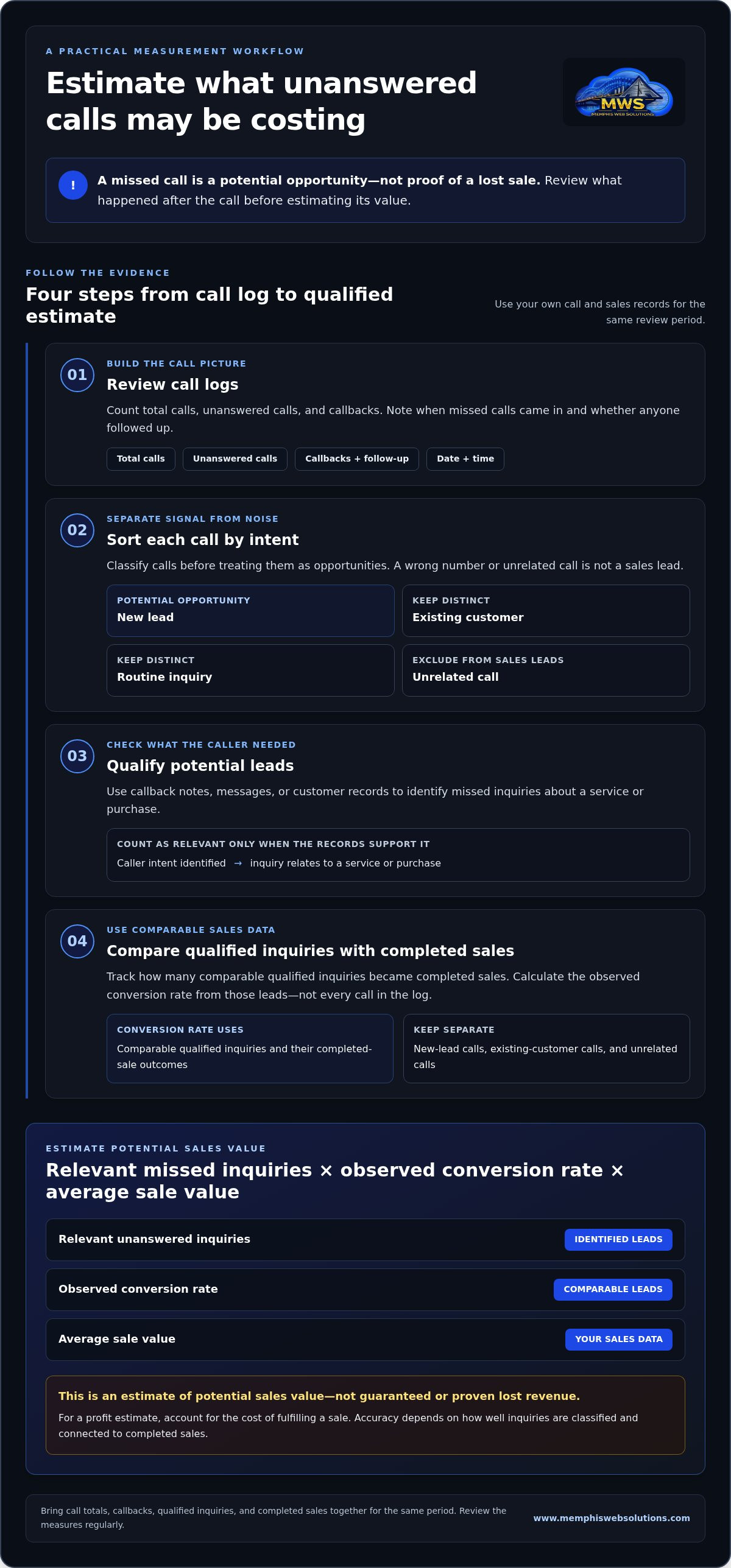
Skip broad industry averages. Your own call and sales records can show whether unanswered calls losing business is a pattern and when it happens. Choose a consistent review period, such as a month, and work through these steps:
- 1. Review call logs. Count total calls, unanswered calls, and callbacks. Note the date and time of missed calls and whether anyone followed up.
- 2. Sort the calls. Label each one as a new lead, existing customer, routine inquiry, or unrelated call. Don’t count every missed call as a sales opportunity.
- 3. Qualify potential leads. Use callback notes, messages, or customer records to identify missed inquiries about a service or purchase.
- 4. Compare outcomes. Track how many qualified inquiries became completed sales. Calculate your observed conversion rate using comparable leads, not every call in your log.
For a cautious estimate, multiply relevant unanswered inquiries by your observed conversion rate, then multiply that result by your average sale value. This gives an estimate of potential sales value, not guaranteed or proven lost revenue. For example, apply the conversion rate for comparable qualified inquiries only to missed calls you’ve identified as relevant. If you want to estimate profit instead, account for the cost of fulfilling a sale.
Which call and sales records should you compare?
Bring together call totals, unanswered calls, callbacks, qualified inquiries, and completed sales for the same period. Keep new-lead calls separate from existing-customer calls and unrelated calls. Record the inquiry type and follow-up outcome so you can see whether missed calls were returned and what happened afterward. An AI lead capture system can help organize incoming inquiries for follow-up and review.
Any estimate depends on your business’s own call and sales data, including how accurately you classify inquiries and connect them to completed sales. Review the same measures regularly and use the results to guide your next step. If inquiry records are difficult to organize, explore lead capture and customer automation options.
How to respond to unanswered calls and capture more leads
Start with the pattern, not a new tool. Review call logs for recurring missed-call periods, such as when staff are on-site or serving customers. Then make ownership and follow-up clear:
- Assign callback ownership. Name the person responsible for returning missed calls and decide who handles callbacks when that person is unavailable.
- Record the outcome. Note whether the caller was a prospect, an existing customer, or an unrelated inquiry. Record whether follow-up led to a conversation, appointment, or sale.
- Match the fix to the gap. Call routing can direct calls to an available team member. A Reservation & Lead Desk can support inquiry handling and bookings. An AI Receptionist can capture caller details when staff can’t answer directly.
These steps turn unanswered calls losing business from a vague concern into a workflow you can improve. If callbacks are being missed, clarify who owns them and how outcomes are recorded before adding another layer of technology.
Where an AI Receptionist can fit into a small-business workflow
An AI Receptionist can handle incoming call inquiries and capture lead details for staff follow-up. An AI Chatbot can handle digital inquiries, while a Reservation & Lead Desk can support bookings and lead capture. Choose an approach based on the calls you receive, what callers need, whether they need to book, and how information should reach your team. A clear handoff keeps staff involved when a personal response matters.
For a small team, match the approach to its actual coverage gaps, then review whether inquiries are being captured and followed up. Memphis Web Solutions’ customer automation services include AI Receptionists and Reservation & Lead Desks to support inquiry handling.
Make every caller easier to reach
Once you know where calls are slipping through, choose a next step your team can sustain. A clear callback routine may be enough to start. If callers need a response while staff are occupied, automated support can keep the conversation moving without pulling someone away from the work in front of them. The goal isn’t to eliminate every missed call. It’s to give genuine inquiries a clear path forward, with ownership and useful caller details passed to the right person. That’s how you turn unanswered calls losing business from a worry into a manageable part of your customer workflow.
Memphis Web Solutions helps businesses in Memphis, Arlington, Germantown, Collierville, Lakeland, Bartlett, Olive Branch, Southaven, and Millington manage customer interactions with AI Receptionists and AI Chatbots, plus Reservation & Lead Desks for inquiries, bookings, and lead capture.
Start by identifying one coverage gap, then choose a practical way to give callers a clear next step.
Frequently Asked Questions
Does every unanswered business call mean a lost customer?
No. An unanswered call could be a wrong number, a routine question, or someone who tries again later. It is more concerning when a caller with a genuine need can’t find a clear next step. To judge whether unanswered calls losing business is a real issue, look for repeat callers, messages, later inquiries, and signs that a prospect chose another option.
How much revenue can one unanswered call cost a small business?
There’s no reliable dollar amount that applies to every missed call. A caller seeking a one-time service may represent a different opportunity from someone who could become a repeat customer. Revenue also differs from profit because fulfilling a sale has costs. Use your own records to assess caller intent and likely customer value rather than treating each ring as a lost sale.
Can an AI Receptionist answer calls when a small-business team is busy?
Yes. An AI Receptionist can handle customer interactions and capture inquiry details while staff are occupied. For example, it can gather the caller’s reason for reaching out and information the team needs to follow up. Set the workflow around the kinds of calls you receive and decide which requests should go to a staff member for a personal response.
What should a business track to understand missed-call trends?
Track when calls come in, which calls go unanswered, whether callers try again, and whether follow-up leads to an appointment or sale. Tag the inquiry type and service area, too. Businesses serving Memphis, Arlington, Germantown, Collierville, Lakeland, Bartlett, Olive Branch, Southaven, and Millington can compare patterns by area to spot where callers may need clearer routing or follow-up.