
Reduce Training Time with AI: 2026 Resource Guide
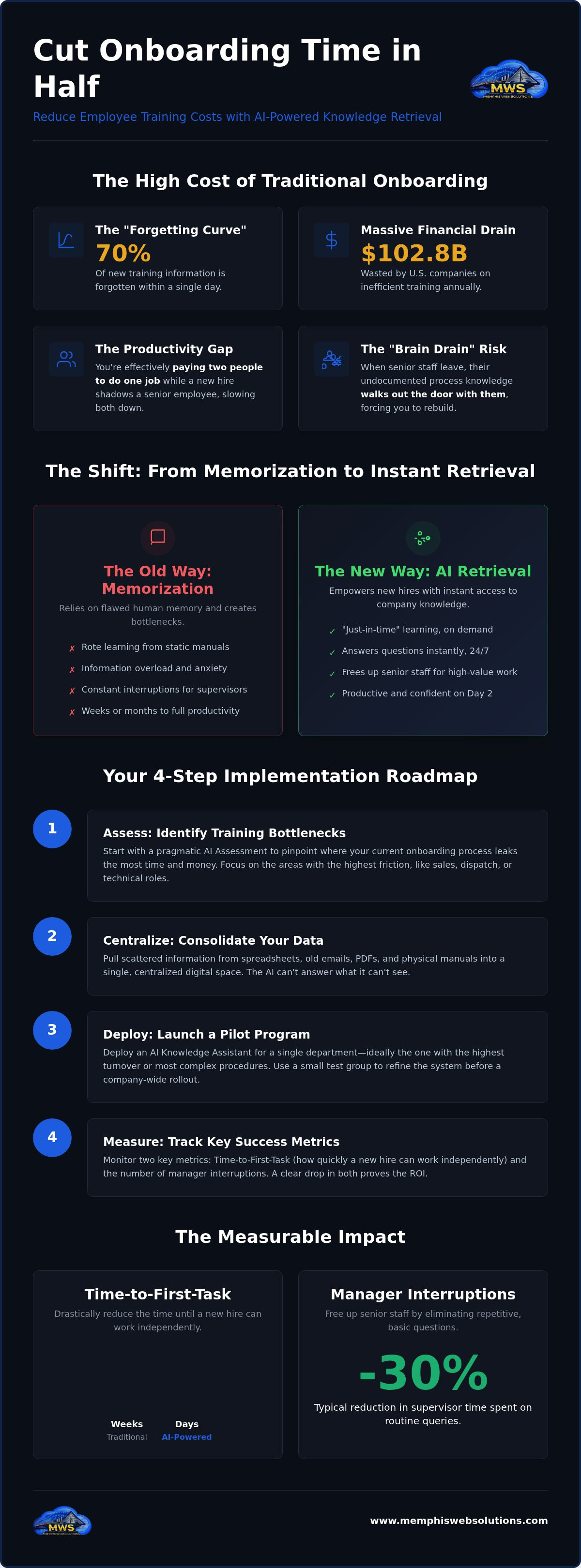
Why are you paying new hires to sit in a room and forget most of what they hear? You can reduce employee training time with AI and stop wasting the $102.8 billion US companies spent on training in 2025. It's the "unproductive" onboarding month. You watch salary go out the door while your hire drowns in manuals. It's a waste of money.
You need people who can do the job, not just memorize a handbook. We'll show you how to replace rote learning with instant knowledge retrieval. Imagine a new hire handling tasks on day two because they have a "brain" for the company that never forgets.
This 2026 guide breaks down how to build that system. We’ll show you how to cut onboarding cycles in half and stop the knowledge drain when staff leave. It's time to move past the overload and get back to work.
Key Takeaways
- Stop fighting the "forgetting curve" where 70% of training info is lost in a single day.
- Replace manual shadowing with an AI Knowledge Assistant that answers new hire questions instantly.
- Learn the exact steps to reduce employee training time with AI by centralizing your company's fragmented data.
- Start with a pragmatic AI Assessment to identify where your onboarding process is leaking time and money.
The End of Onboarding Overload: Why Traditional Training Fails
Traditional training relies on a flawed premise: that humans are good at remembering manuals. They aren't. Most employees forget roughly 70% of new information within 24 hours. This creates the "Training Gap," those expensive weeks where a new hire is on the payroll but cannot work without constant supervision. You're effectively paying two people to do one job. It's a massive drain on your bottom line and kills momentum.
Shadowing also creates a "brain drain" risk. When a senior staff member leaves, their specific process knowledge often walks out the door with them. If your training relies on one person watching another, you lose your company's best secrets every time someone moves on. You shouldn't have to rebuild your operations from scratch every few years just because a veteran employee retired.
Moving from Memorization to Knowledge Retrieval
The goal isn't to force people to memorize more. It's to help them find answers faster. To reduce employee training time with AI, you must shift to a retrieval model. Instead of digging through a dusty binder or an old email chain, an employee simply asks a question and gets the result. This stops the "information overload" that causes new hires to quit or make costly mistakes.
An AI Knowledge Assistant is a 24/7 digital mentor that never forgets a detail. This "just-in-time" learning removes the anxiety of being the new person. When a hire knows they can get the right answer in seconds, they start handling basic tasks on day two. They don't need to wait for a manager to be free to answer a simple question. They just ask the system, get the fact, and keep moving. It turns a month of "learning" into a week of doing.
AI Tools for Knowledge Management and Organization
Traditional Learning Management Systems (LMS) are a chore. They require you to build courses, record videos, and write quizzes from scratch. Most small businesses don't have time for that. Instead, use AI Knowledge Assistants, Smart Wikis, and internal AI Chatbots to reduce employee training time with AI. These tools don't need you to write a single lesson. They scan your existing PDFs, training manuals, and even old email threads to build a comprehensive training base. If the information exists in your company files, the AI finds it and explains it.
Field technicians and contractors especially benefit from voice-activated AI. They can ask for a specific wiring diagram or a safety protocol while their hands are full on a job site. It's about practical utility in the moment. However, don't confuse these internal tools with a customer-facing bot. Understanding the customer service knowledge base vs internal knowledge base distinction is vital for security. One handles public FAQs; the other stores your private, operational secrets.
Building a Living SOP with AI Assistants
Your Standard Operating Procedures (SOPs) shouldn't be static binders on a shelf. AI creates a living SOP that updates in real-time as your business evolves. Record a senior team member explaining a complex fix or a client preference; the AI transcribes and indexes it into a searchable module instantly. You can even train new staff on high-performing sales flows by integrating an AI receptionist with your CRM. This captures real-world interactions and turns them into actionable training data. Want to see how this fits your specific workflow? A pragmatic AI Assessment can pinpoint exactly which tools will work for your business.
Implementing AI Training Solutions for Memphis Small Businesses
You don't need a total company overhaul to see results. Start with a no-nonsense audit. Identify where your training bottlenecks live. Is it the sales floor? Is it the dispatch desk? Use an AI Assessment to find the friction. Once you know the problem, centralize your data. Pull the scattered info from spreadsheets, old emails, and physical manuals into one digital space. This is how you reduce employee training time with AI without hiring extra management.
Next, deploy a localized AI Knowledge Assistant. It acts as the "first point of help" for every new hire. Instead of tapping a supervisor on the shoulder, they ask the AI. We recommend starting with a single department. Pick the one with the highest turnover or the most complex procedures. Fix that first. The momentum from one successful department will make the rest of the rollout much smoother.
Measuring Success: From Weeks to Days
How do you know it's working? Watch two specific metrics: Time-to-First-Task and manager interruptions. If a new hire handles a lead on day two instead of day ten, you've won. If your senior staff spends 30% less time answering basic questions, your overhead is dropping. It's a simple, measurable return on investment.
Before you jump in, consider a veteran-owned AI business readiness assessment. It's a pragmatic way to see if your data is actually ready for automation. Start small with a pilot program. Test the system with three people. Refine the answers. Once it's solid, roll it out to the whole team. You'll save time, money, and your sanity.
Take Control of Your Onboarding Cycle
Paying for weeks of unproductive shadowing is a constant drain on your business growth. Moving from traditional memorization to instant knowledge retrieval stops the "brain drain" and gets new hires working effectively by day two. By centralizing your scattered manuals and deploying a localized Knowledge Assistant, you can reduce employee training time with AI while significantly lowering management stress. It's about utility and common sense, not tech-industry hype.
As a veteran-owned business right here in Memphis, we prioritize accountability and direct support for Shelby County owners. You don't need a massive, expensive overhaul to see a difference; you just need tools that work as hard as you do. We focus on utility-first solutions that solve real problems on the ground for local teams.
Let's get your team productive and put your focus back where it belongs: growing your business.
Frequently Asked Questions
Can AI really replace hands-on training for my employees?
AI doesn't replace the human touch; it replaces the binder. It handles the repetitive "how-to" questions so your senior staff can focus on the nuanced skills that require a person. You'll reduce employee training time with AI by letting the software manage the facts while you manage the talent. It's about freeing up your experts from being human search engines.
How much time does it take to set up an AI Knowledge Assistant?
Setup is faster than building a traditional manual. If you have your processes in PDFs, emails, or spreadsheets, an AI Knowledge Assistant can often be functional within a few weeks. It doesn't require you to write new lessons. The system simply scans what you already have. The most time-consuming part is often just gathering your fragmented files into one place.
Is my business data safe when using AI tools for internal training?
Data security is a priority for any local business. We focus on internal knowledge bases that keep your proprietary information private and away from public training models. Your operational secrets stay within your company's digital walls. It's important to choose tools that prioritize data sovereignty so your competitive advantages don't end up in a competitor's search results.
What types of small businesses benefit most from AI training tools?
Service-based companies with high turnover or specialized field work see the biggest impact. If you run a dispatch center, a sales team, or a contracting firm with complex safety protocols, these tools are essential. They help you reduce employee training time with AI by giving staff instant answers on the job. Any business where "looking it up" takes longer than five minutes is a prime candidate.