
HubSpot vs. Integrated Business Systems: A Pragmatic Comparison for 2026
You might be paying a $1,300 monthly "tech-tax" for a software name your customers will never see. When comparing HubSpot vs integrated business systems in 2026, it's easy to get blinded by massive feature lists and the hype surrounding the new Breeze AI updates. You probably feel like you need the biggest name in the industry to stay competitive. But if your team is struggling to navigate a complex interface while leads slip through the cracks, that "industry leader" is actually a bottleneck.
We understand the frustration of managing disconnected apps and paying for seats you don't use. You want a system that just works. This guide provides a pragmatic look at whether a massive CRM or a lean, AI-driven integrated system is the right utility for your local operations. You'll discover how to lower your overhead and ensure every lead is captured 24/7 without manual entry. We're breaking down the 2026 pricing tiers, the reality of onboarding fees, and why a straight-talking solution often outperforms a bloated platform.
Key Takeaways
- Identify the "tech-tax" hidden in per-user pricing models and how it impacts your monthly overhead.
- Evaluate HubSpot vs integrated business systems to see if a brand-name CRM or a lean, custom-built utility serves your local team better.
- Move beyond static lead forms with an AI Receptionist that captures caller details and books appointments 24/7.
- Learn the practical steps to audit your tech readiness and consolidate tools so you stop missing leads in your local service area.
The CRM Trap: Why HubSpot Isn’t Always the Answer for Local Teams
Most local business owners think they need the biggest name on the market to look professional. They sign up for a name-brand platform, pay the steep monthly fees, and then realize they've stepped into a trap. A standard Customer Relationship Management (CRM) is essentially a digital filing cabinet. It's a database that stores names and numbers. In contrast, an integrated business system is a custom-built ecosystem of tools that talk to each other perfectly. Think of it as a 24/7 employee rather than just a spreadsheet.
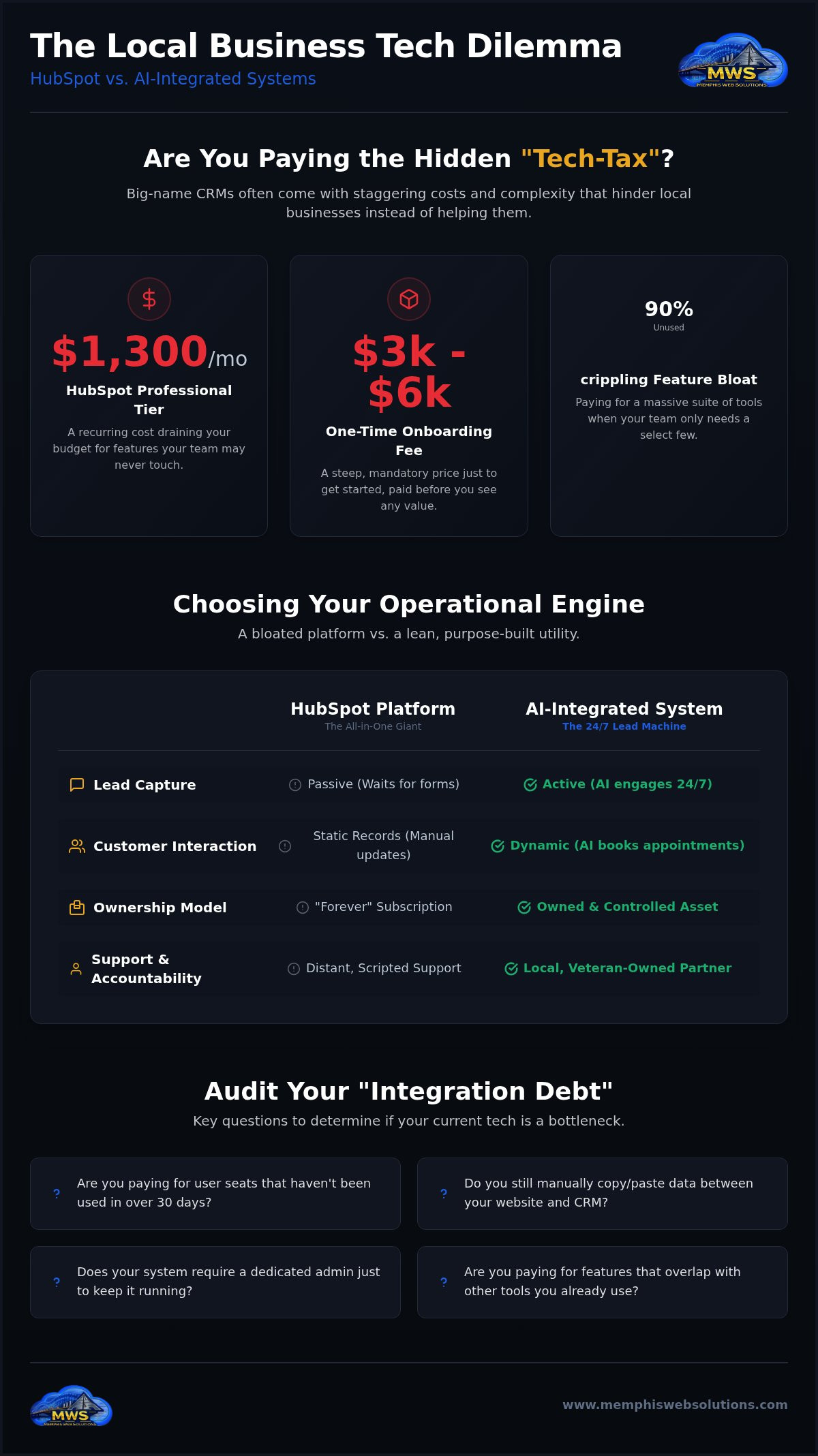
Let's look at the "tech-tax." In 2026, HubSpot’s Professional tier starts at roughly $1,300 per month. That's a heavy drain on a local service team’s budget. You're often forced to pay for "seats" and features you'll likely never touch. Most businesses suffer from "Feature Bloat." They pay for 90% of tools they never even open. When evaluating HubSpot vs integrated business systems, you have to ask: am I paying for utility or just a logo?
The Hidden Cost of "All-in-One" Platforms
Busy contractors or law firms don't have months to master a steep learning curve. HubSpot often requires a one-time onboarding fee ranging from $3,000 to over $6,000 just to get started. That's a lot of cash to spend before you've even captured your first lead. Big Tech support usually means waiting for a distant representative to read from a script. We believe in local, veteran-owned accountability. You need a partner who understands the local market, not a distant software provider that treats you like a ticket number.
When HubSpot Makes Sense vs. When It Doesn’t
Perform a simple "Utility Check." Does your team actually need enterprise-grade reporting and complex marketing lifecycle stages? If you're a local shop focused on service delivery, probably not. Your priority should be reducing business overhead with AI while keeping your operations lean. In the HubSpot vs integrated business systems debate, the winner is always the system that actually gets used. If a platform is too complex for your team to navigate, leads will fall through the cracks. It's that simple.
Comparison: HubSpot Hubs vs. Custom Integrated Systems
HubSpot relies on passive lead capture. You place a form on a page and wait for someone to type. An AI Lead Capture System is active. It interacts with callers and web visitors in real-time. It qualifies prospects before they ever hit your inbox. This is the fundamental shift when looking at HubSpot vs integrated business systems. One is a digital bucket; the other is a smart filter that protects your time.
Customer interaction follows the same pattern. HubSpot provides static records that require manual updates. A 24/7 AI Receptionist actually does the work. It answers questions, checks availability, and books appointments while you sleep. Choosing between a massive platform and a lean stack is a classic debate of single-vendor vs best-of-breed systems. For local service providers, "best-of-breed" means choosing tools that solve specific operational headaches without the extra weight.
Ownership matters. Subscription models are a "forever" expense. If you stop paying, your data often becomes a hostage. Integrated systems focus on building a utility that you own and control. When an integration needs a tweak, you don't wait on a global support queue. You work with a local partner who ensures the system stays upright and profitable. If you're tired of the tech-tax, it might be time to explore a leaner alternative that prioritizes your bottom line.
Feature Parity for Memphis Service Businesses
Local businesses in Arlington or Germantown don't need enterprise-level social media scheduling. They need booked jobs. AI Receptionists and Lead Desks replace the need for expensive HubSpot "Service Hub" seats by automating the most common customer touchpoints. You get the same result as a high-tier subscription but without the unnecessary complexity. These systems are tailored to your specific zip codes and service areas, ensuring your automation feels like a neighbor, not a bot.
The "Integration Debt" Warning
Integration Debt is the cost of maintaining software connections that don’t serve the bottom line. It's the hidden friction that slows down your growth.
- Are you paying for seats that haven't been logged into for 30 days?
- Do you still have to manually copy data from your website to your CRM?
- Does your current system require a dedicated "admin" just to keep it running?
- Are you paying for features that overlap with other tools in your stack?
Building a 24/7 Lead Machine Without the Tech-Tax
Stop comparing and start building. If you want a system that captures leads while you sleep, you need a plan that prioritizes utility over novelty. The transition from a bloated CRM to a lean, automated stack happens in three clear steps. First, start with a Pragmatic AI Business Readiness Assessment. You can't automate a process you haven't documented. This audit identifies where your current "tech-tax" is draining resources and which tools actually move the needle.
Second, consolidate your communication. If you're missing calls in Collierville or Bartlett, you're losing revenue to the competitor who picks up first. An AI Receptionist ensures every inquiry is handled immediately, whether it's 2 PM or 2 AM. Finally, connect your website and SEO directly to your lead desk. When weighing HubSpot vs integrated business systems, the goal is a seamless flow from the first click to the final invoice. You don't need fifty features. You need a system that works every time a prospect reaches out.
Local Support vs. Silicon Valley Support
Silicon Valley doesn't understand Shelby County market dynamics. They see you as a subscription number in a database. We see you as a neighbor. Having a local, veteran-owned partner means real accountability. When your lead system is your lifeline, you can't wait for a distant support ticket to be resolved. We provide the steady hand and local presence required to keep your operations running at peak efficiency. It's about human connection, not just digital interactions.
Your Next Pragmatic Move
You don't have to stay trapped in a messy spreadsheet or an overpriced CRM. Transitioning to a lean system is simpler than you think. It starts by cutting the waste and focusing on the tools that capture and convert leads. If you're ready for a straight-talking solution that just works, explore Memphis Web Solutions for a no-nonsense system audit. Let's look at your HubSpot vs integrated business systems options and find the utility that fits your specific business goals.
Stop Paying the Tech-Tax and Start Growing
Choosing between HubSpot vs integrated business systems isn't just about software features. It's about how you value your time and your overhead. You've seen how massive CRM platforms can trap you with per-user fees and feature bloat. A lean, integrated system offers a pragmatic alternative. It replaces static databases with active tools like 24/7 AI-driven lead capture. You get a solution that works around the clock without the Silicon Valley price tag.
We're a veteran-owned small business focused on local accountability. We don't believe in selling you 90% more software than you actually need. Our goal is to provide Memphis service providers with a straight-talking partner and tools that just work. You deserve a system that captures every lead in Collierville, Bartlett, or Germantown without the manual entry or the tech-tax headache.
Take the first step toward a more efficient operation today. Your business deserves a utility that works as hard as you do.
Frequently Asked Questions
Is HubSpot too expensive for a small service business in 2026?
HubSpot's Professional tier starts at $1,300 per month with onboarding fees that can exceed $6,000. For a local service provider, that is a heavy overhead. When comparing HubSpot vs integrated business systems, the cost-to-utility ratio often favors a leaner stack. You shouldn't pay for enterprise reporting when you just need booked jobs. A lean system cuts the "tech-tax" and focuses on your actual revenue.
What is the main difference between a CRM and an integrated business system?
A CRM is a database for storing information while an integrated business system is a custom ecosystem that performs work. Traditional CRMs hold names and numbers in a digital filing cabinet. An integrated system connects your lead capture, AI Receptionist, and follow-up tools. It automates tasks that usually require manual entry. It moves beyond passive storage to active utility that protects your time.
Can an AI Receptionist work with my existing CRM?
An AI Receptionist can integrate with most modern software stacks. It acts as the front-line worker handling calls and inquiries. Once it qualifies a lead, it sends that data straight to your database. You don't have to abandon your current tools to gain 24/7 lead capture. It's a pragmatic way to upgrade your operations without a massive, expensive overhaul of your entire business.
How long does it take to set up an integrated business system in Memphis?
Implementation usually takes between two and four weeks. We don't believe in long setup phases that stall your growth. We start with a quick audit of your current pains and build the system to solve those specific problems. Since we're local to Memphis, you get direct accountability. Your system is ready to handle local customers in weeks, not months.