
AI vs. Live Receptionist Cost: A Practical Comparison for Small Businesses
The lowest monthly price can become the most expensive choice if callers wait or usage charges add up. The highest price may pay for coverage your business doesn’t need. The real question behind AI vs live receptionist cost is what it takes to handle calls reliably, not just answer them.
It’s reasonable to worry that missed calls mean lost business while wondering whether automation can handle a frustrated customer or an unusual request. This comparison looks beyond headline rates to the full cost of in-house staff, outsourced answering, and AI, including coverage, billing rules, and follow-up work. You’ll learn how call volume and complexity affect the choice, which routine inquiries AI can handle, and why clear handoff rules matter. The goal is a practical fit, not an all-or-nothing bet on technology.
Key Takeaways
- Compare AI vs live receptionist cost using the full monthly picture, including coverage, setup, usage, and follow-up work.
- Use your own call volume and qualified outcomes to estimate the cost per useful result, not just the advertised rate.
- Match routine, repeatable inquiries and lead capture to automation, while keeping a clear path to a person for sensitive or complex calls.
- Review when calls come in and what callers need before choosing AI, live coverage, or a blended approach.
AI vs. live receptionist cost: what are you actually paying for?
An in-house receptionist is an employee who may answer calls alongside other front-desk duties. An outsourced live answering service uses people outside your business to answer calls within an agreed scope. An AI receptionist handles designated interactions through automation. Blended coverage combines approaches, for example, using AI for routine inquiries and routing calls that need personal attention to a person.
Total cost includes coverage, setup, usage, follow-up work, and unresolved calls. That’s the useful distinction in an AI vs live receptionist cost comparison. A low software fee tells only part of the story if staff still need to sort incomplete messages or return calls the system couldn’t resolve.
Compare equivalent coverage and tasks. If an employee answers during business hours, don’t compare that cost with a service covering a different window. List the work each option handles, such as taking messages, routing calls, managing appointment inquiries, and responding to unusual requests. A salary and a software subscription aren’t equivalent if one includes broader duties or more coverage.
What counts as a live receptionist?
A live receptionist may be your employee or someone answering through an outsourced service. Depending on the arrangement, they may take messages, route calls, or handle appointment inquiries. The scope and staffing setup vary, so compare the specific tasks included rather than assuming every service works the same way. The broader term virtual assistant covers both human-powered and AI-powered support, but phone coverage still needs to be compared by what it actually handles.
Start with your call patterns: when calls arrive, which questions are routine, and which calls require judgment or empathy. This gives you a fair basis for comparing employee, outsourced, AI, or blended coverage. It also helps identify work your team may still need to do after each call.
How to calculate AI vs. live receptionist cost for your business
Build the comparison from your own records, not a vendor’s sample scenario. Use current payroll, vendor quotes, call logs, and conversion data, and label every assumption. That keeps the AI vs live receptionist cost comparison grounded in what your business spends and gets in return.
| Cost area | What to record |
|---|---|
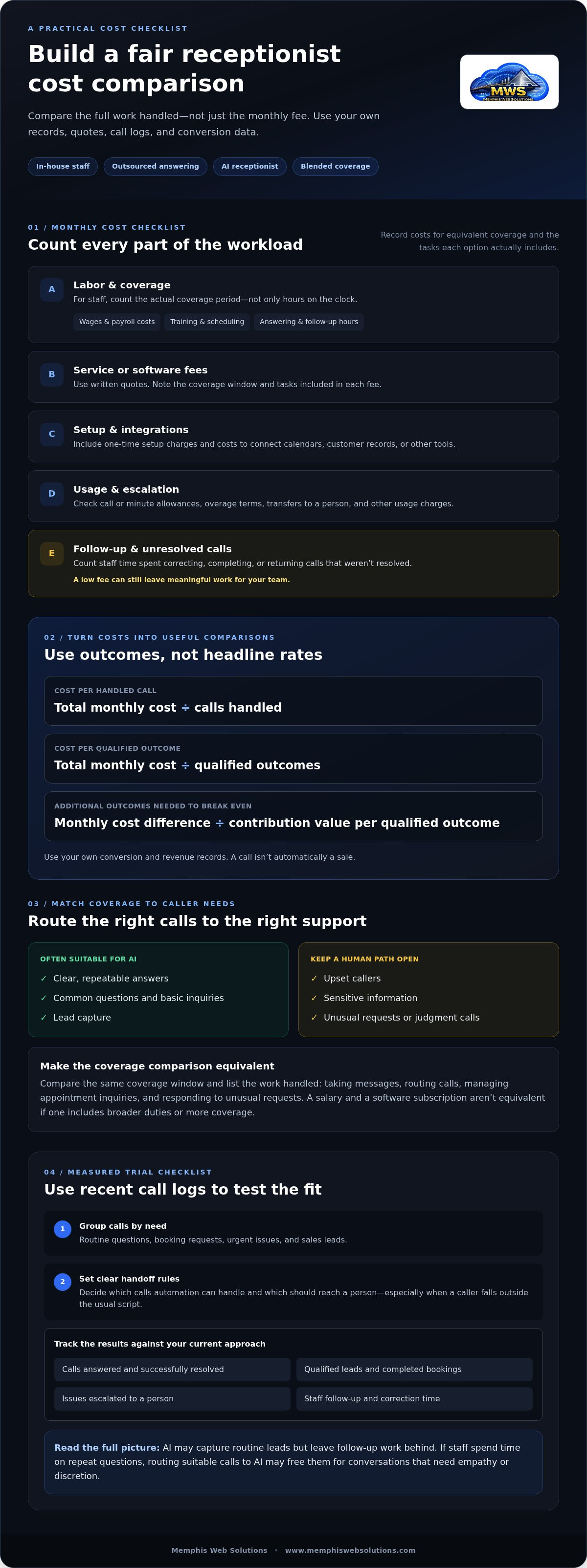
| Labor and coverage | Wages, payroll costs, training, scheduling, and the hours staff spend answering or following up. |
| Service or software fees | Quoted monthly fees and the coverage and tasks they include. |
| Setup and integrations | One-time setup charges and any costs to connect calendars, customer records, or other tools. |
| Usage and escalation | Call or minute allowances, overage terms, transfers to a person, and other usage charges. |
| Follow-up time | Staff time spent correcting, completing, or returning calls that weren’t resolved. |
For staff, count the actual coverage period, not just the hours they’re on the clock. For AI or a human answering service, use written quotes and include setup, integrations, usage, and human escalation. AI can support AI in business, but its value depends on the work it completes and the follow-up it leaves behind.
Cost per handled call = total monthly cost ÷ calls handled. To compare business results, calculate cost per qualified outcome as total monthly cost ÷ qualified outcomes. You can then estimate how many additional outcomes a higher-cost option needs to break even: monthly cost difference ÷ contribution value per qualified outcome. Use your own conversion and revenue records. A call isn’t automatically a sale.
These figures can also clarify what to include in an AI customer communication plan.
When does an AI or live receptionist make better business sense?
AI can be a practical fit for calls with clear, repeatable answers, such as common questions, basic inquiries, and lead capture. A live receptionist may be better suited to a caller who is upset, shares sensitive information, or needs a judgment call. The right choice depends on what callers need, not just how often the phone rings.
For businesses in Memphis, Arlington, Germantown, Collierville, Lakeland, Bartlett, Olive Branch, Southaven, and Millington, review call patterns across your operating hours. Do calls cluster while staff are busy, or arrive when your team isn’t available? There’s no single schedule that fits every business. A blended model can use AI for suitable routine calls and route defined situations to a person, keeping a human path open without assigning every interaction to staff.
How can a small business test the right coverage model?
Start with recent call logs. Group calls into routine questions, booking requests, urgent issues, and sales leads. For each category, decide whether automation can handle the interaction or whether it should reach a person. Set clear handoff rules, especially for callers whose needs fall outside the usual script.
Run a measured trial and compare the results with your current approach. Track:
- Calls answered and calls successfully resolved
- Qualified leads and completed bookings
- Issues escalated to a person
- Staff time spent following up or fixing incomplete interactions
Review the results alongside your full cost figures. If AI captures routine leads but leaves staff with extensive follow-up, the apparent savings may not tell the whole story. If staff spend much of their time on repeat questions, routing suitable calls to AI may free them for conversations that need empathy or discretion. This is a more useful way to judge AI vs live receptionist cost for your business.
Choose coverage that earns its place
A useful AI vs live receptionist cost comparison goes beyond the monthly fee. Count coverage, setup, usage, and staff follow-up, then weigh the total against calls answered and qualified outcomes. Routine inquiries and lead capture may suit AI, while sensitive or complex conversations can call for a person. A blended approach can cover both needs.
Memphis Web Solutions offers AI Receptionist and AI Chatbot services, along with a Reservation & Lead Desk for inquiries, bookings, and lead capture. The veteran-owned and operated small business serves Memphis and nearby communities, including Arlington, Germantown, Collierville, Lakeland, Bartlett, Olive Branch, Southaven, and Millington.
Start by reviewing your call patterns and defining when callers should reach a person. Explore Memphis Web Solutions’ AI receptionist options to plan coverage around your customers and team.
Frequently Asked Questions
Is an AI receptionist cheaper than a live receptionist?
An AI receptionist may have a lower direct operating cost for routine calls, but the lowest monthly fee isn’t automatically the best value. Compare equivalent coverage and tasks, then include setup, usage charges, staff follow-up, and calls that remain unresolved. If callers often need sensitive or complex help, human coverage or a blended model may justify the added cost.
How do I calculate the cost of a live receptionist for my small business?
Add the costs tied to the coverage you need. For an employee, include wages, employer payroll costs, benefits, training, scheduling, and time spent answering calls or following up. For an outsourced service, use its quoted fees and include setup, usage, and escalation charges. Divide the full monthly cost by calls handled or qualified outcomes to compare value.
Can an AI receptionist replace a human receptionist?
It can take on selected, repeatable call tasks, but it won’t be the right fit for every interaction. AI may help with routine questions and lead capture, while a person can bring empathy, discretion, and judgment to sensitive or unusual situations. Set clear rules for when callers reach a human. A blended approach can reduce routine workload while keeping that path open.
What is the best way to compare AI receptionist and live answering service costs?
Use the same coverage hours, call types, and service expectations for each option. Include quoted fees, setup, usage, staff follow-up, and unresolved calls, then compare cost per handled call and qualified outcome. For businesses in Memphis, Arlington, Germantown, Collierville, Lakeland, Bartlett, Olive Branch, Southaven, and Millington, use local call patterns to assess when coverage matters. That’s a practical way to judge AI vs live receptionist cost.