
AI Tools for Knowledge Management: A Practical Guide
What if the answer your team needs is already in a document, email, or app nobody can find? When that happens repeatedly, ai tools for knowledge management and organization can help staff find and use trusted business information instead of relying on memory or searching several places.
Giving answers to AI only helps when the underlying information is reliable. A useful setup starts with current source material, clear ownership, and appropriate access. This guide explains how to compare tool types, choose a manageable first workflow, and set expectations for dependable answers.
You’ll see how to organize trusted sources, where an AI Knowledge Assistant can fit into daily work, and how to expand once you know what’s useful. These steps apply to teams in Memphis, Arlington, Germantown, Collierville, Lakeland, Bartlett, Olive Branch, Southhaven, and Millington.
Key Takeaways
- Use ai tools for knowledge management and organization to help staff find answers in trusted business sources.
- Start with one recurring question, then identify where the answer lives and who should be able to access it.
- Compare tools by how well they search, cite sources, fit daily work, and respect access controls.
- Keep source documents current and review important answers so your team can use AI with confidence.
What AI Tools for Knowledge Management and Organization Actually Do
AI tools for knowledge management and organization help a business capture, organize, search, and answer questions using its own information. The goal isn’t simply to store more files. It’s to make useful knowledge easier to put to work. The broader practice of knowledge management focuses on how organizations create, share, and use what they know; AI can make parts of that process easier to access.
A searchable repository helps staff locate a document or passage. An AI knowledge tool can go further by summarizing connected material or answering a question using trusted sources. The difference is practical: search points staff to information, while an AI response interprets it. An AI answer is only as dependable as its source material. If the source is outdated, unclear, or incomplete, the response may be too.
What information can an AI knowledge tool help a small team use?
Useful starting points include current procedures, service details, staff guidance, and frequently asked questions. For example, staff might look up the steps for handling a common request or check how a service should be described to a customer. Before connecting documents, assign an owner to each source, remove or label outdated versions, and use names that make the contents clear. “Customer refund steps, current” is easier to recognize than “final-v3.”
That groundwork helps staff and AI find the same dependable answer. Begin with a small set of documents people use regularly, then check that each one is current, readable, and consistent with the others. If two files give different instructions, resolve the conflict before connecting them. A focused collection gives the tool a clearer foundation without turning a small team’s information into another hard-to-manage system.
How to Choose AI Knowledge Management Tools for Your Team
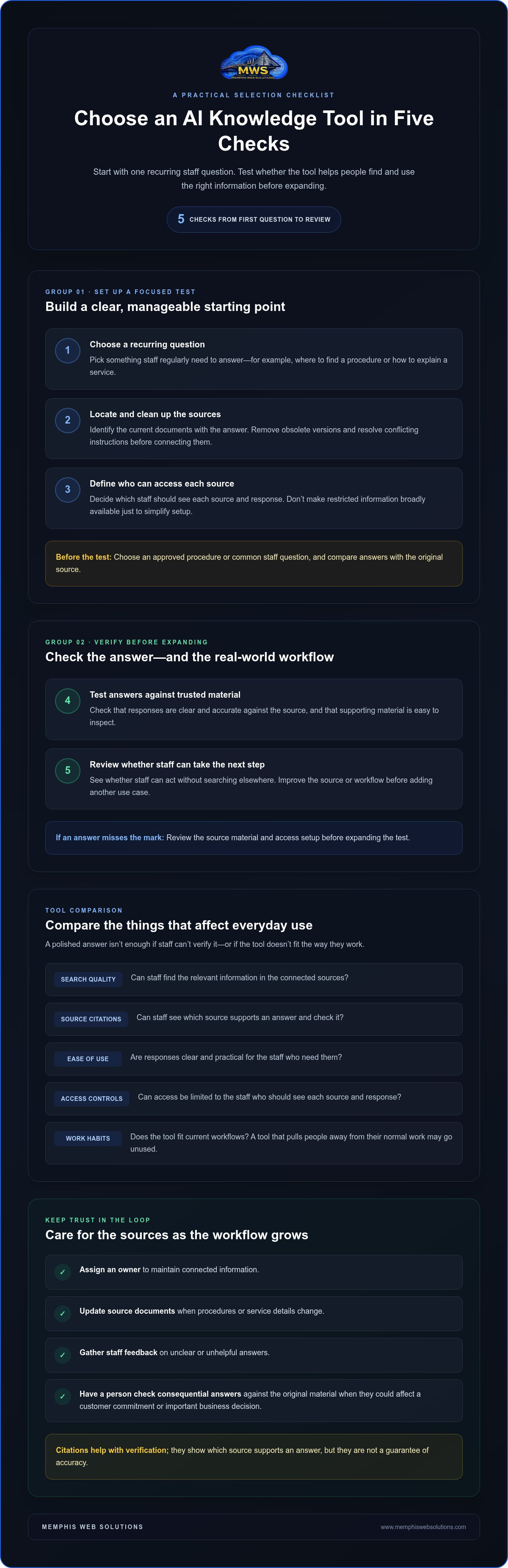
Start with the work, not a long feature list. The right ai tools for knowledge management and organization should solve a recurring problem without forcing staff to change every habit at once. Use this five-step checklist:
- Choose a recurring question. Pick something staff regularly need to answer, such as where to find a procedure or how to explain a service.
- Locate the sources. Identify the current documents that contain the answer and remove conflicting or obsolete versions.
- Define access. Decide which staff should see each source and response. Don’t make restricted information broadly available just to simplify the setup.
- Test answers. Check whether responses are clear, accurate against the source, and linked to supporting material.
- Review results. See whether staff can act without searching elsewhere, then decide what to improve before adding another workflow.
Compare tools on search quality, source citations, ease of use, access controls, and fit with current work habits. A polished answer isn’t enough if staff can’t verify it. Likewise, a tool that requires people to leave their normal workflow may go unused. For a closer look at how these systems support small businesses, read our AI Knowledge Assistant: A 2026 Small Business Guide.
How can a small business test an AI knowledge tool before expanding?
Keep the first test focused and low-risk. Choose one approved procedure or a common staff question, then compare each answer with the original source. Note whether staff can take the next step without extra searching and whether the response makes its supporting information easy to check. If an answer misses the mark, review the source material and access setup before adding more workflows. A practical AI readiness assessment can help Memphis-area teams prioritize suitable use cases before expanding.
A focused test gives you evidence for the next decision: improve the source, adjust the workflow, or try another use case. Memphis Web Solutions offers AI knowledge assistance to help businesses put this kind of support to practical use.
Put AI Knowledge Organization to Work Without Losing Trust
Good answers need ongoing care, not just a well-organized launch. Assign clear ownership of connected information, limit access to staff who need it, and update source documents when procedures or service details change. When an answer could affect a customer commitment or an important business decision, have a person check it against the original material.
Citations help staff verify an AI answer by showing which source supports it. They make it easier to spot outdated guidance or a response that doesn’t match the document. Treat citations as a way to check an answer, not a guarantee of accuracy.
Keep the rollout simple:
- Assign an owner to maintain the source material.
- Gather staff feedback on unclear or unhelpful answers.
- Update the source documents when information changes.
- Expand only after the workflow proves useful in daily work.
When should a business consider an AI Knowledge Assistant?
Consider one when staff repeatedly search separate documents or apps for the same business information. An AI Knowledge Assistant can make those materials easier to use in routine work. An AI Assessment can help identify suitable opportunities and priorities. The aim is a practical fit for the team, not AI for its own sake.
Memphis Web Solutions provides AI Knowledge Assistants and AI Assessments to help businesses put their information and AI plans to practical use. Explore practical AI solutions for your business to consider a next step that fits your workflow.
Make Your Business Knowledge Easier to Use
Useful AI starts with a focused workflow, trusted source material, and answers staff can check. Choose a recurring question, test whether a tool helps people find and use the right information, then improve the process before expanding. That keeps ai tools for knowledge management and organization practical instead of adding another complicated system.
Memphis Web Solutions offers AI Knowledge Assistants and AI Assessments, with a focus on practical AI-driven automation for local businesses. As a veteran-owned and operated small business, we help teams consider where AI can make everyday work more manageable.
You don’t need to organize everything at once. Start with one useful answer, build from what works, and give your team a clearer path to the knowledge they need.
Frequently Asked Questions
What are AI tools for knowledge management and organization?
AI tools for knowledge management and organization help a team collect, arrange, search, and use its business information. Some tools locate relevant documents; others summarize material or answer questions using connected sources. For example, staff can use one to find an approved procedure or understand service guidance without searching separate folders and apps.
How can a small business use AI to organize its knowledge?
Start with a recurring staff question, gather the current documents that answer it, and organize them with clear labels and an assigned owner. Teams serving customers in Memphis, Arlington, Germantown, Collierville, Lakeland, Bartlett, Olive Branch, Southhaven, or Millington can test a knowledge assistant on routine procedures or FAQs, then improve the source material based on staff feedback.
Can AI knowledge management tools give incorrect answers?
Yes. An AI tool can misread a document, combine details poorly, or rely on outdated material. Connect it to current, approved sources, set appropriate access, and check important responses against citations and original documents. Treat answers as assistance, not automatic authority, especially when they affect customer commitments or business decisions.
What should I look for in an AI knowledge management tool?
Look for reliable search, visible source citations, ease of use, suitable access controls, and a fit with your team’s existing work habits. Test it with a real question and your current information. Does it help staff find a verifiable answer without extra searching? Memphis Web Solutions offers AI Knowledge Assistants and AI Assessments to help businesses plan practical AI use.